
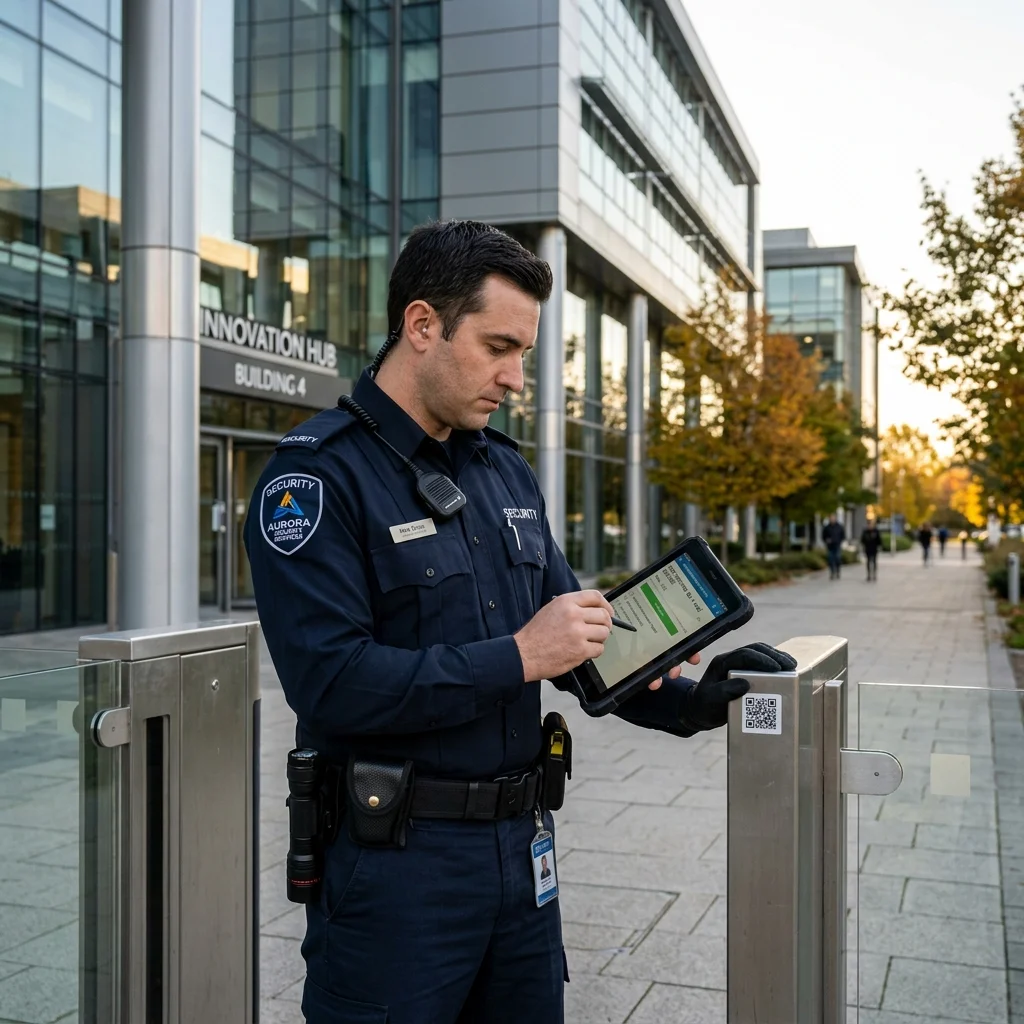
Prove the guard was actually on post.
A code tapped into a phone does not prove identity or presence. A security agency needs to show that a specific, verified officer was physically at a specific post at a specific time, and that the hours billed to the client match hours a punch can actually prove.
An agency bills per guard-hour at a post. Without proof, that hour is a dispute waiting to happen.
A post covered on paper is not the same as a post covered in fact. If a punch can be entered by anyone with the code, an agency cannot tell a client, an insurer or a court who was actually there. Buddy punching and phantom posts are not just an internal integrity problem, they show up directly on the invoice: a client questioning whether a post was really staffed for the hours billed has, without independent proof, only the agency's word to go on. Every punch needs to carry its own proof: the location it was taken at, a live photo of the person taking it, a confidence score on whether that photo matches the officer assigned to the post, and a record of how that punch location relates to the post's actual address.
checks
in every punch, on post
question sets
punch-in and punch-out differ
photo required
the punch button stays disabled without it
Every punch at a post carries a geofence check, a photo, and a safety check, not a code and a timestamp.
Punch in and punch out both run the same checks, in the same order. That matters most on posts nobody else is watching: an overnight, single-officer assignment with no supervisor or colleague on site to confirm the officer showed up. Full gate-by-gate detail lives on Verification & Enforcement.
Check 1
Geofence check
An admin draws a boundary around the post address and sets the radius. Every punch is checked against live distance from that boundary, and out-of-geofence punches are flagged for review.
Check 2
Photo capture
A live photo is required to continue — the punch button stays disabled until it's done. On an overnight, single-officer post with nobody else present, this is the only visual confirmation of who is actually there.
Check 3
Face confidence
The photo returns a numeric confidence score, not a simple pass or fail, giving an agency a real signal to review instead of a checkbox that only shows the punch happened.
Check 4
Safety Q&A
A short set of hazard questions is reviewed and confirmed before the shift starts. Punch-in and punch-out use different question sets, not the same quiz repeated at the end of the post.
One shift, several posts on the tour, not one fixed spot.
Coverage isn't always a single door. A patrol assignment moves an officer between several checkpoints across a property or a contract during one shift, and each stop needs its own proof, not one punch standing in for the whole tour. A single shift can nest up to five job-site check-in and check-out stops, each independently timestamped and photo-documented, so a multi-checkpoint patrol produces a separate, verified record per stop.
Each checkpoint on the tour gets its own timestamped, photo-documented check-in and check-out, not a single punch covering every stop on the property.
The path between checkpoints, on a map.
Distance and travel time between waypoints are computed from real GPS readings and laid over a map for every leg of the tour, so the route an officer actually walked between checkpoints is reviewable after the fact, not just the total hours they reported for the shift.
Per-leg distance and travel time sit next to each checkpoint's photo and timestamp, on the same record.
A guard's punch is tied to the post's actual address, not a raw GPS point.
The Enhanced Punch report uses real routing data to show Distance From Job, Travel Time and Traffic Time for every punch, reconciled against the job the officer was assigned to. This is raw distance and elapsed time only, not a mileage reimbursement or dollar calculation, but it is exactly what a billing dispute needs: whether a punch actually traces back to the billed post.
When a client questions an invoice, the agency has more than a timesheet to answer with: the geofence distance at the post, computed per punch, sitting next to the hours billed.
A selfie and a map pin, in and out.
Every punch carries an in and out selfie photo alongside a map pin, so the reconciled distance and travel-time data sits next to visual and location confirmation for the same event. For a post covered overnight with no one else present, that pairing is the record: who, where, and how far from where they were supposed to be.
In/out selfies and map pins are attached to the same punch record the distance and travel-time figures are computed from, all readable from the Enhanced Punch report.
An incident record built for OSHA and workers' compensation, not a text message to a supervisor.
An incident at a post, a trespasser, an injury, a break-in, needs to hold up when a client, an insurer or a court reviews it later. An incident record is organized into the categories that review will actually ask for: employee details, incident details, medical and investigation notes, workers' compensation status, and injury information, with up to five photos attached directly to the record.
Incident and comp details capture the job, weather, supervisor, date and time and who investigated it, plus the DWC first-report-of-injury form and its dates on the same record.
Evidence attaches up to five photos directly to the incident, not a separate file to track down later.
Every call and message to a guard, logged against that person.
A dispatcher checking in on an officer at a post, or an officer calling in an issue, builds a full timestamped history against that specific person, not a note in a shared inbox. Admins log a call with an explicit direction choice and notes; a separate per-officer message thread carries the written conversation. Both directions, dispatcher-initiated and officer-initiated, are attributed and timestamped. This is the same calling and messaging framework covered on Sales & Client Growth.
Call Out / Call In logs every dispatcher- or officer-initiated call into that person's history.
A dedicated message thread keeps the written conversation with that officer in one place, separate from the call log.
Go deeper
Practical answers for your evaluation
A guard on post,
proven, not assumed.
We will map Hirebase to your compliance framework,
your ERP and your region.